
April 17, 2026
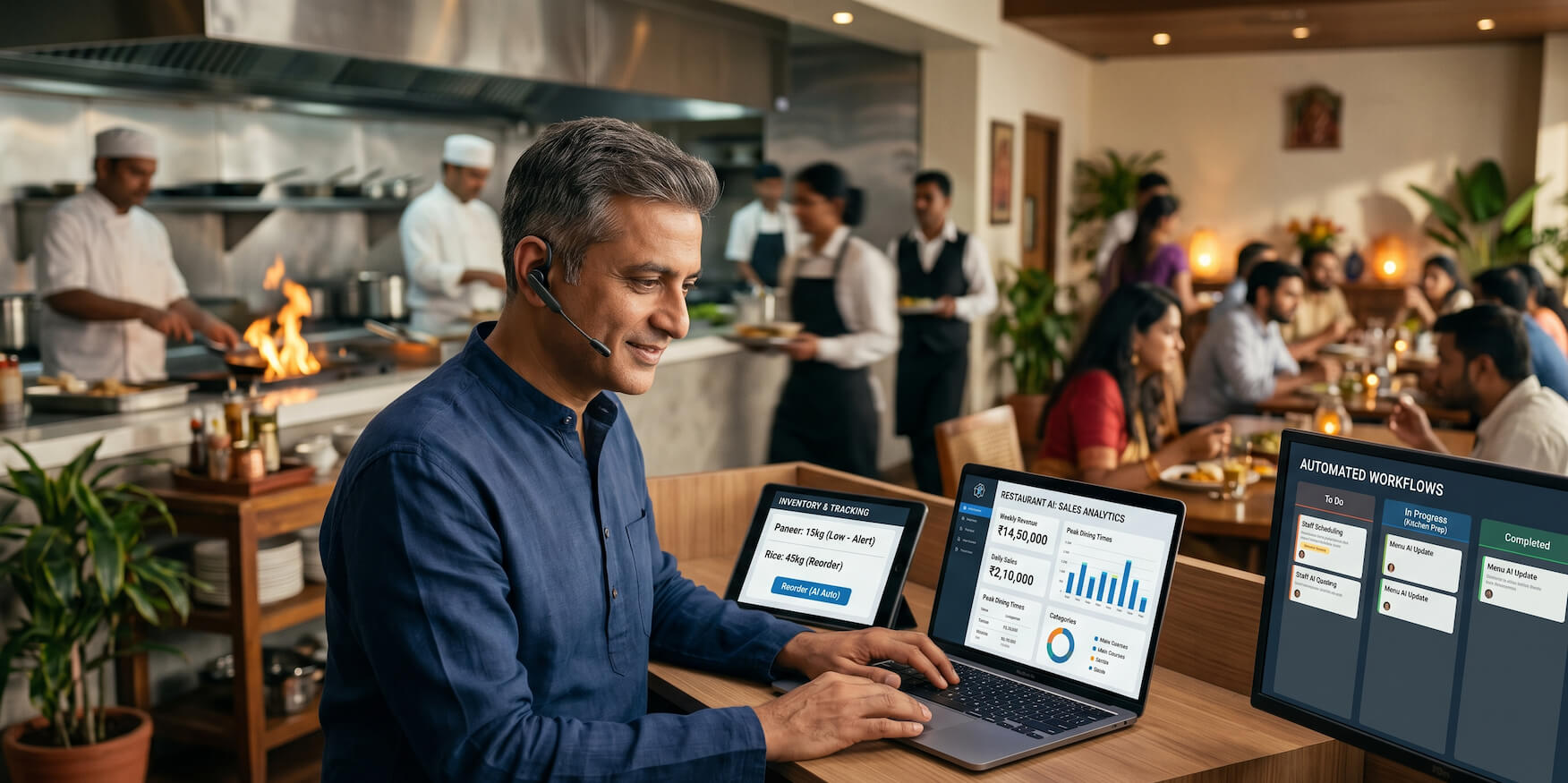
Running a restaurant in 2026 is no longer just about food quality or service—it is about how efficiently you operate every part of your business.
From managing staff schedules and handling orders to tracking inventory and running marketing campaigns, restaurant owners are constantly balancing multiple responsibilities at once.
Over time, this creates a major challenge: limited time and increasing workload.
In this environment, productivity is not just helpful—it is essential for survival and growth.
This is where AI tools are making a significant impact. By automating repetitive tasks, reducing manual effort, and improving decision-making, AI allows restaurants to operate more efficiently without increasing staff or complexity.
The result is a business that runs smoother, responds faster, and delivers a better experience to customers.
Restaurant profit margins are typically very narrow, often ranging between 3% and 9%. Because of this, even small inefficiencies can have a noticeable impact on overall profitability.
AI tools improve productivity by addressing some of the most time-consuming and error-prone aspects of restaurant operations.
They help reduce food waste by predicting demand more accurately. They automate workflows that would otherwise require manual input. They also optimize staffing by analyzing peak hours and customer patterns.
These improvements are not isolated. They compound over time, leading to lower costs, faster operations, and higher revenue.
What makes AI particularly valuable is that it does not just save time—it improves how decisions are made, turning reactive management into proactive planning.
Modern POS systems have evolved into intelligent platforms that do far more than process transactions.
AI-powered systems like Toast POS continuously analyze sales data to identify patterns in customer behavior. This allows restaurant owners to understand which items perform best, when peak hours occur, and how demand changes over time.
Instead of relying on intuition, you gain access to real-time insights that support faster and more accurate decision-making.
For example, staffing can be adjusted based on predicted demand, reducing unnecessary labor costs while ensuring that service quality remains high. Menu adjustments can also be made based on performance data, helping you focus on items that generate the most revenue.
This makes the POS system one of the most impactful tools for improving overall productivity.
Inventory management is often one of the most time-consuming and costly aspects of running a restaurant.
Without proper systems, it is easy to over-order ingredients, leading to waste, or under-order, leading to service disruptions.
AI-driven inventory tools solve this problem by tracking stock levels in real time and using historical data to forecast future demand. This allows restaurants to maintain optimal inventory levels without constant manual monitoring.
Automated purchasing further simplifies the process by generating orders based on predicted needs. This not only saves time but also reduces errors and ensures consistency.
Over time, these improvements lead to significant cost savings and a more streamlined operation.
Customer communication is a major part of restaurant operations, but it can also be a significant drain on time and resources.
AI-powered chatbots and voice assistants help by handling routine interactions automatically. They can take orders, manage reservations, and answer common questions without requiring staff involvement.
This is especially valuable during peak hours, when handling calls and messages manually can overwhelm your team.
By automating these interactions, restaurants can maintain fast response times while freeing up staff to focus on in-person service.
In addition, modern voice AI systems have become highly accurate, reducing order errors and improving the overall customer experience.
Restaurants generate a large amount of data every day, but without proper tools, much of this data goes unused.
AI analytics platforms collect and process information from multiple sources, transforming it into actionable insights. This includes sales trends, customer preferences, and operational performance.
One of the most valuable applications is demand forecasting. By predicting future trends, restaurants can plan inventory, staffing, and promotions more effectively.
This reduces uncertainty and allows for more strategic decision-making, which directly improves productivity and profitability.
Marketing is essential for attracting customers, but it often becomes a time-consuming task that competes with operational priorities.
AI-powered tools like Canva simplify this process by enabling quick creation of professional-quality visuals. Whether it is social media posts, promotional offers, or menu designs, everything can be created efficiently without specialized skills.
This allows restaurant owners to maintain consistent marketing efforts without dedicating excessive time or resources.
As a result, marketing becomes a streamlined part of the workflow rather than a separate burden.
As restaurants adopt multiple tools, managing them individually can become inefficient.
Automation platforms act as connectors, allowing different systems to work together seamlessly. For example, orders can be automatically synced with inventory, customer data can be updated across platforms, and notifications can be triggered without manual input.
This reduces repetitive tasks and ensures that information flows smoothly across the business.
The end result is a more cohesive and efficient operation where less time is spent managing systems and more time is spent improving the business.
The relationship between productivity and profitability is becoming increasingly clear in the restaurant industry.
Restaurants that adopt AI tools are not just saving time—they are improving every aspect of their operations, from cost control to customer experience.
By automating routine tasks and leveraging data, they are able to operate more efficiently and respond more effectively to changing conditions.
This creates a competitive advantage that becomes more significant over time.
While AI tools can significantly improve internal operations, they do not automatically bring in new customers.
This is where many restaurants fall short.
Even with optimized workflows and reduced costs, growth depends on visibility and customer acquisition. Without a strong online presence, the benefits of productivity improvements remain limited.
The most successful restaurants are combining operational efficiency with strong digital presence.
They are not only using AI to streamline their workflows—they are also using AI-powered platforms to attract and convert customers online.
For example, many restaurant owners are now learning how to build a business website without coding using AI
This allows them to create professional websites quickly, without technical complexity.
They also explore why RocketPages is the best AI website builder to understand how performance, speed, and SEO impact their ability to attract customers.
By combining these strategies, restaurants can increase online orders, improve visibility, and build stronger relationships with their audience.
Choosing the right tools starts with identifying where your time is being lost.
If daily operations feel overwhelming, a smart POS system will provide immediate relief. If inventory management is consuming too much effort, AI-driven inventory tools will have the biggest impact.
For customer communication challenges, chatbots and voice assistants are highly effective. For improving decision-making, analytics tools are essential.
The key is to focus on your specific needs and build a system that supports your workflow rather than complicating it.
While AI can significantly improve efficiency, it is important to use it thoughtfully.
Over-automation can lead to impersonal customer experiences or create unnecessary complexity if too many tools are used at once.
The goal should be to enhance operations while maintaining a human touch where it matters most.
AI tools are redefining how restaurants operate in 2026 by making it possible to achieve more with fewer resources.
They help reduce manual work, improve decision-making, and create more efficient workflows.
However, true success comes from combining these productivity gains with a strong online presence that attracts and converts customers.
When these elements work together, restaurants are able to grow faster, operate smarter, and remain competitive in an increasingly demanding industry.
Stay up to date with the latest tips, expert insights, product reviews, and step-by-step guides to help you grow, create, and succeed—no matter your industry or passion.