
April 16, 2026
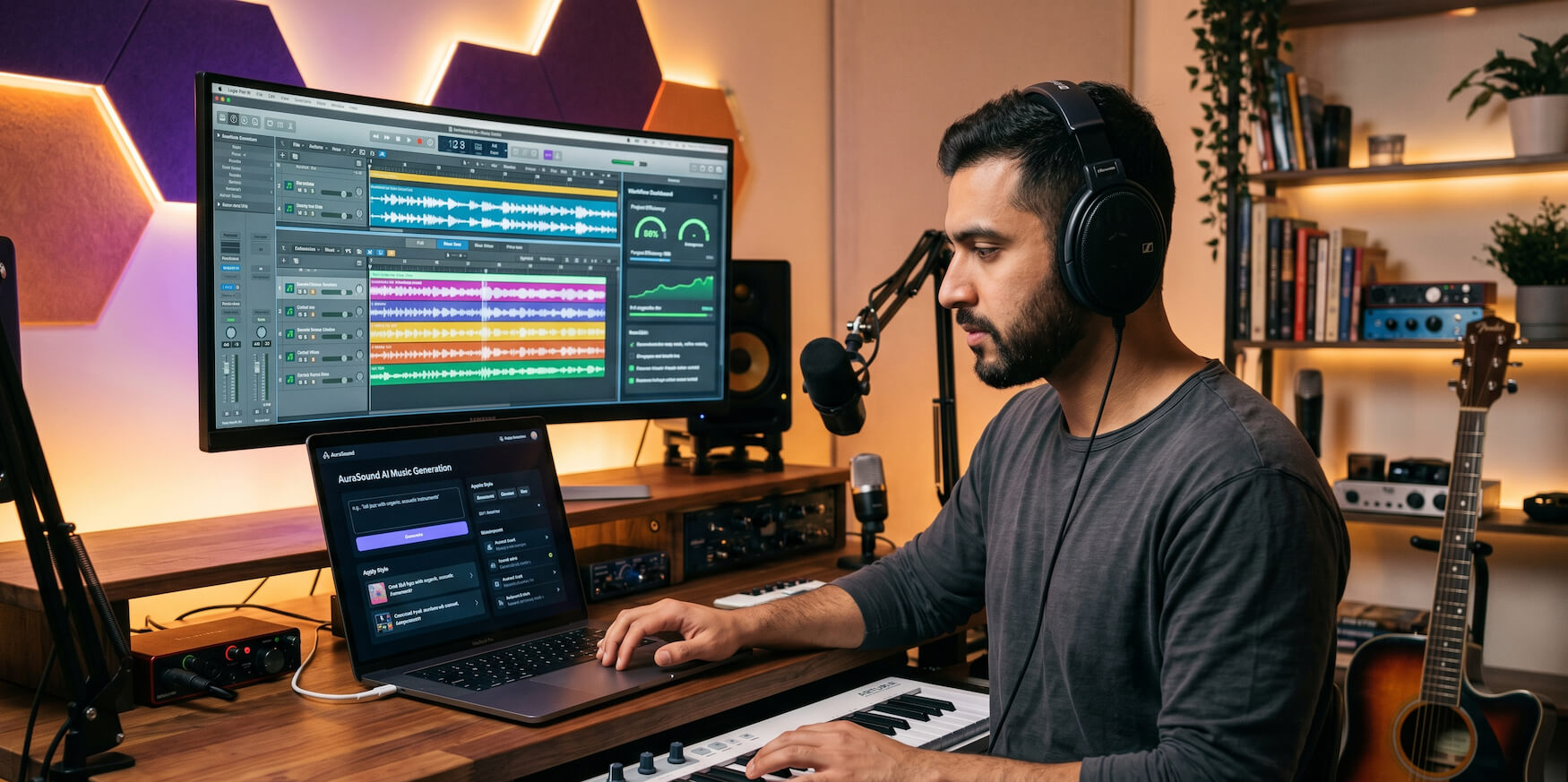
In 2026, being a musician is no longer defined only by creative talent. The modern music landscape demands much more than just writing good songs or producing good sounds. Today, musicians are expected to operate like full creative businesses.
A single independent artist often has to manage multiple roles at the same time, including composing music, recording tracks, editing audio, distributing releases, and promoting their work across digital platforms. Each of these tasks requires time, energy, and consistency.
The challenge is not creativity anymore—it is workload management.
This is exactly where AI tools are transforming the industry. Instead of replacing musicians, AI acts as a support system that removes repetitive and technical burdens from the creative process.
With AI assistance, musicians can now reduce production time significantly, automate routine tasks, and maintain a more consistent output without feeling overwhelmed.
The real shift is simple: Musicians are no longer limited by time—they are limited only by ideas.
In this guide, you will explore the most effective AI tools for productivity in 2026 and understand how they fit into a modern music workflow.
Music production used to be a slow and highly technical process. Creating even a single track often required multiple stages—writing, composing, recording, editing, mixing, mastering, and finally promotion. Each stage could take hours or even days depending on complexity and experience.
In 2026, AI has significantly compressed this timeline.
Modern AI systems are capable of generating melodies, building full arrangements, and even assisting with mastering in a fraction of the time it used to take. This allows musicians to move from idea to finished product much faster than traditional workflows.
More importantly, AI reduces the mental load of switching between tasks. Instead of constantly moving between creative thinking and technical execution, musicians can stay focused on their artistic direction while AI handles repetitive production work in the background.
This creates a major advantage: More music is created in less time, and with less creative exhaustion.
As a result, artists can release music more consistently, experiment with new sounds more freely, and maintain a healthier creative rhythm without burnout.
ChatGPT has become a powerful assistant for musicians because it supports the earliest and often most difficult stage of music creation—idea development.
For many musicians, the hardest part of writing a song is not production but figuring out where to start. ChatGPT helps remove that barrier by generating structured ideas, lyrical directions, and thematic suggestions that can be immediately turned into songs.
Instead of facing a blank page, musicians can explore multiple creative directions in minutes. They can refine lyrics, adjust tone, or even experiment with different storytelling approaches before committing to a final concept.
Beyond songwriting, ChatGPT also helps musicians plan their releases, organize content strategies, and maintain consistency across platforms.
In practical terms, it acts like a creative collaborator that is always available, never tired, and capable of generating endless variations of ideas.
Suno is one of the most impactful productivity tools for musicians because it drastically reduces the time required to turn ideas into finished tracks.
Instead of manually building every layer of a song, musicians can simply describe what they want in natural language. This could include mood, genre, lyrical theme, or emotional tone. The system then generates a complete song that includes vocals, instrumentation, structure, and lyrical content.
This approach is especially powerful for productivity because it enables rapid experimentation. Musicians can test multiple versions of a song idea in a very short period of time, helping them quickly identify what works and what doesn’t.
Over time, this speeds up the creative decision-making process. Artists are no longer guessing how a concept might sound—they can hear it instantly and refine it accordingly.
Suno essentially transforms music production into a fast iteration cycle between idea and finished output.
Mixing has traditionally been one of the most time-consuming parts of music production. It requires careful adjustment of levels, frequencies, and effects to achieve a balanced sound.
iZotope changes this process by using AI-assisted audio processing to analyze tracks and suggest intelligent improvements. Instead of manually adjusting every parameter, musicians receive guided recommendations that significantly reduce trial-and-error time.
This is particularly useful for independent artists who may not have access to professional audio engineers. With AI support, they can achieve a polished and professional sound without needing advanced technical expertise.
The key productivity benefit is simple: What once took hours of technical adjustment can now be completed in minutes of guided refinement.
Mastering is the final stage of music production, where a track is optimized for playback across different devices and platforms. Traditionally, this process required specialized engineers and expensive studio time.
LANDR automates this process by analyzing audio and applying professional mastering profiles instantly. Musicians can choose different sound styles depending on the mood or genre of their track and receive a finished master within minutes.
This significantly speeds up the release process. Instead of waiting days for external mastering, artists can finalize and publish their music almost immediately after production.
This creates a major productivity advantage: The gap between finishing a song and releasing it becomes nearly zero.
Descript introduces a completely different way of handling audio editing by allowing users to edit spoken or recorded content in a text-based format.
Instead of working with complex waveforms and timelines, musicians can edit audio by editing text transcripts. Removing a word or sentence automatically removes the corresponding audio section.
This makes editing significantly faster and more intuitive, especially for musicians who also create podcasts, interviews, or spoken content.
The productivity improvement comes from replacing technical editing steps with a familiar interface: text editing instead of audio engineering.
Notion AI is not a music production tool, but it plays an important role in overall productivity by helping musicians organize their creative work.
Musicians often deal with scattered ideas, unfinished drafts, release schedules, collaboration notes, and marketing plans. Without structure, this can easily become overwhelming.
Notion AI helps centralize all of this information in one place. Musicians can track song ideas, organize release calendars, plan promotional campaigns, and manage collaborations in a structured system.
The productivity value lies in reducing mental clutter and keeping creative work organized and actionable.
One of the biggest changes in the music industry today is that success is no longer based solely on talent or creativity. Instead, consistency has become equally important.
Musicians who release regularly, experiment often, and maintain steady engagement tend to grow faster than those who focus only on occasional high-quality releases.
AI tools support this by reducing the time required for each stage of production. However, experts also highlight that using too many tools at once can create complexity rather than efficiency. The most effective approach is selective adoption—choosing only the tools that directly improve workflow instead of stacking unnecessary systems.
In essence: Productivity is not about using more tools—it is about removing friction from creation.
Even with powerful AI tools, many musicians still face a major limitation: visibility.
Creating music efficiently does not automatically lead to audience growth. Without a strong online presence, even consistent output can remain unnoticed.
This is why modern musicians combine production tools with platforms that help them present their work professionally and reach wider audiences.
Successful musicians are not just focusing on production—they are also focusing on presentation and branding.
Many artists now learn how to build a business website without coding using AI to showcase their music, portfolio, and collaborations in a professional format.
They also explore why AI website builders are the best option for musicians to create fast, optimized, and visually strong online identities that help convert listeners into long-term fans.
This combination of AI production tools and digital presence creates a complete career ecosystem rather than just isolated music output.
Instead of trying to use every available tool, musicians benefit more from building a focused workflow where each tool serves a specific purpose.
For example, ChatGPT can support songwriting, Suno can accelerate music creation, iZotope can improve mixing, LANDR can handle mastering, Descript can simplify editing, and Notion AI can organize everything into a structured system.
When used together intentionally, these tools form a streamlined workflow that reduces effort while increasing output quality and speed.
AI tools are fundamentally reshaping how musicians work in 2026. They are not replacing creativity—they are removing the technical and repetitive barriers that slow it down.
This allows musicians to focus more on expression, experimentation, and consistent output rather than being stuck in time-consuming production cycles.
However, real success still depends on how these tools are used. Productivity alone is not enough. Visibility, consistency, and personal branding remain essential for long-term growth.
The musicians who succeed in this new era are those who combine AI-powered efficiency + consistent creativity + strong online presence together into one continuous workflow.
Stay up to date with the latest tips, expert insights, product reviews, and step-by-step guides to help you grow, create, and succeed—no matter your industry or passion.