
April 15, 2026
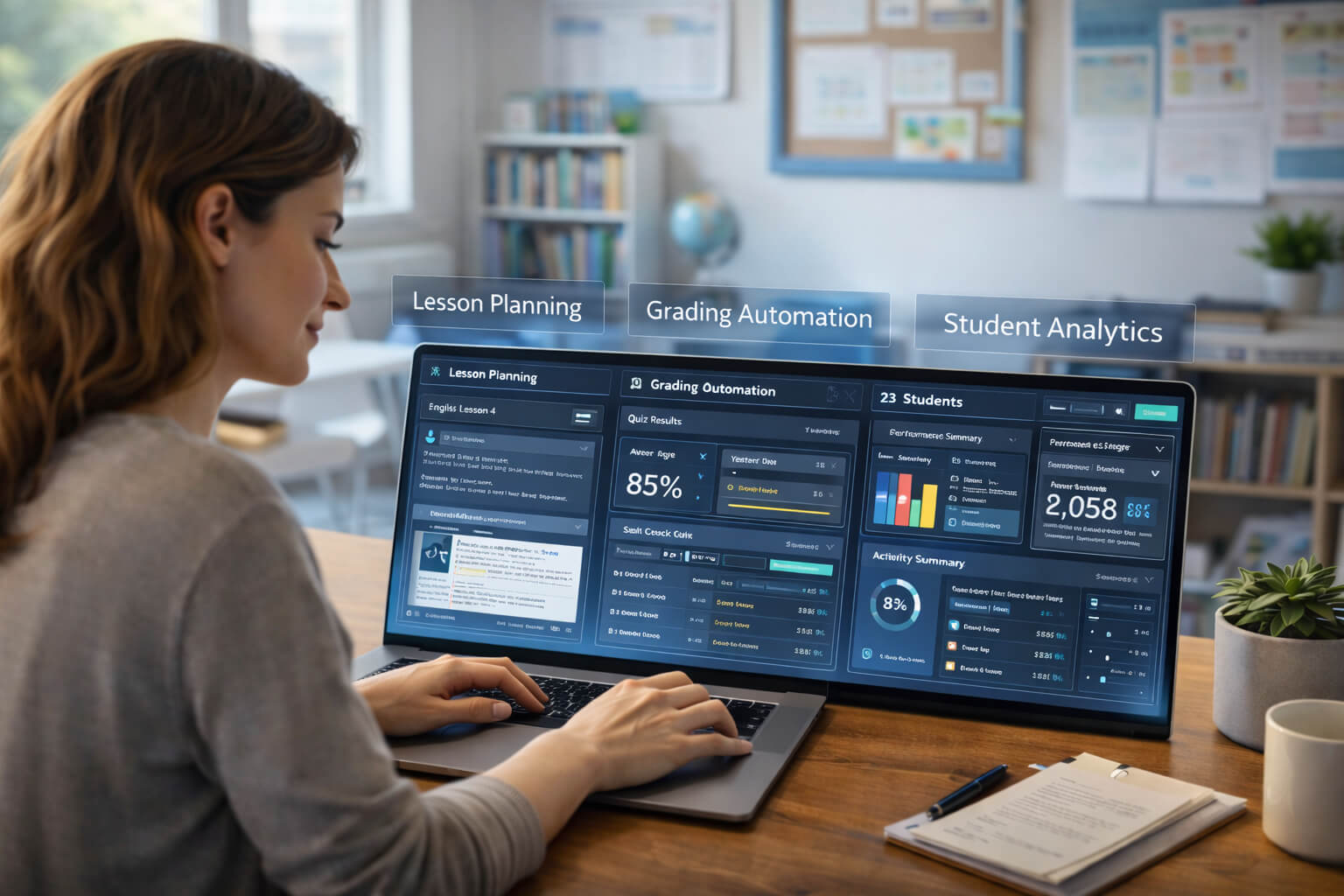
Teaching in 2026 is no longer limited to delivering lessons inside a classroom. It has evolved into a multi-layered profession where educators are expected to manage content creation, student engagement, performance tracking, and administrative responsibilities simultaneously.
This growing complexity has made productivity one of the most critical challenges in modern education.
AI tools are addressing this challenge not by replacing educators, but by reshaping how work gets done at a fundamental level.
Instead of spending hours on repetitive tasks, educators can now:
The real shift is not just speed—it’s the ability to maintain high quality while reducing effort.
Most discussions about AI focus on saving time. But that’s only part of the story.
The deeper advantage is that AI reduces cognitive load, which is one of the biggest hidden challenges in teaching.
Educators constantly make micro-decisions:
Over time, this leads to fatigue and inefficiency.
AI tools change this by providing:
This shifts the role of the educator from: creator from scratch → editor and strategist
And that is where true productivity gains happen.
ChatGPT functions as a cognitive partner that enhances how educators think, plan, and execute their work.
Instead of manually designing every lesson element, educators can generate complete instructional frameworks that include objectives, activities, and assessments. This allows them to focus on refining and adapting rather than building from scratch.
It also plays a crucial role in concept clarity, helping educators explain difficult topics in multiple ways. When students struggle, teachers can instantly generate alternative explanations, analogies, or simplified breakdowns.
Another important benefit is the ability to create an entire content ecosystem—lesson plans, worksheets, quizzes, and revision materials—all aligned and consistent.
Over time, this transforms teaching from a fragmented process into a systematic and scalable workflow.
While ChatGPT helps generate ideas and content, Notion AI ensures that everything is organized, accessible, and reusable.
Educators often waste time searching for materials they’ve already created. Notion eliminates this by acting as a centralized system where all resources are stored in a structured way.
It allows teachers to build:
This turns scattered work into a cohesive operational system.
The AI layer further enhances this by summarizing notes, generating structured documents, and refining content—making organization not just static, but intelligent.
MagicSchool AI simplifies AI adoption by removing the need to figure out how to use it.
Instead of experimenting with prompts, educators can directly use predefined tools that generate lesson plans, rubrics, and communication templates.
This reduces uncertainty and ensures outputs are:
It is especially valuable for beginners because it provides a guided AI experience, allowing them to benefit from automation without needing technical expertise.
Google Gemini enhances productivity by integrating AI into everyday tools, making it an invisible but powerful support system.
Educators frequently deal with large volumes of information—documents, reports, and emails. Gemini reduces the time spent processing this information by summarizing and structuring it into actionable insights.
It also improves communication efficiency by drafting emails and organizing responses, helping educators maintain professionalism while saving time.
Its ability to analyze data and extract patterns further supports informed decision-making in teaching strategies.
Visual communication is essential for engagement, but traditionally requires time and effort.
Canva AI allows educators to instantly create presentations, worksheets, and visual aids that are both professional and engaging.
This improves:
It also ensures consistency in design, which enhances clarity and professionalism across teaching materials.
Grading is one of the most repetitive aspects of teaching.
Gradescope automates evaluation by grouping similar answers and applying consistent grading criteria.
This not only saves time but also improves fairness and accuracy.
Additionally, it provides insights into student performance, helping educators identify common learning gaps and adjust their teaching strategies accordingly.
Even after adopting all these tools, many educators face a hidden limitation: Their productivity improves, but their reach does not.
They create high-quality content—but it remains confined to:
This is where smart educators are making a strategic move.
They are not just using AI tools—they are also building platforms to publish and scale their work.
Instead of struggling with technical complexity, educators are now learning how to: build a business website without coding
This allows them to:
Without needing any technical background.
Once they are ready to grow, the next step is selecting the right platform.
That’s why many educators explore: why RocketPages is the best AI website builder
This helps them understand how to build:
When you combine:
You create a system where:
AI is not just making educators faster—it is making them more capable, more strategic, and more scalable.
The educators who succeed in 2026 are not the ones who simply use tools.
They are the ones who: Turn productivity into growth
AI Tools → Efficient Workflows → Online Platform → Scalable Impact
Stay up to date with the latest tips, expert insights, product reviews, and step-by-step guides to help you grow, create, and succeed—no matter your industry or passion.