
April 17, 2026
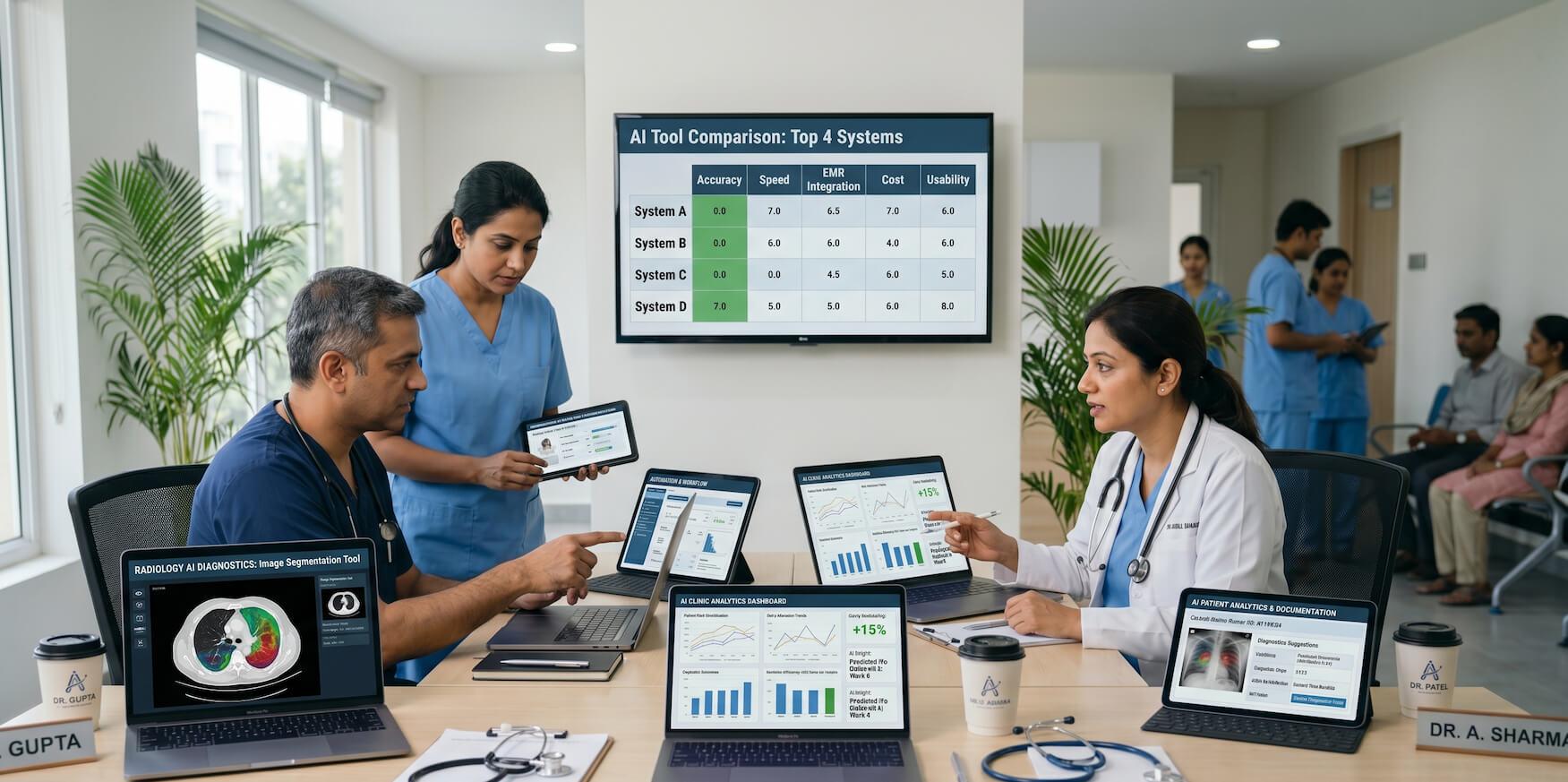
Artificial intelligence is transforming healthcare at every level—from small clinics to large hospital systems.
But there’s a growing problem.
Not every AI tool delivers real value.
Some tools promise automation but add complexity. Others generate insights but fail to integrate into real workflows. And many simply solve one small problem while creating new inefficiencies elsewhere.
This makes one thing clear: Choosing the right AI tools is no longer optional—it’s a strategic decision that directly impacts care quality, efficiency, and business growth.
In this guide, we go beyond surface-level features and break down the real differences between AI tools in healthcare, helping you understand what actually works in 2026.
Healthcare is fundamentally different from most industries.
Decisions are time-sensitive. Errors are costly. And compliance requirements are strict.
Introducing the wrong tool into this environment doesn’t just slow things down—it can create serious risks, including:
On the other hand, the right tools can transform operations.
They can reduce hours of manual work, improve diagnostic accuracy, and enable healthcare providers to deliver faster and more personalized care.
The key difference lies not in whether a tool uses AI—but in how well it fits into real-world healthcare workflows.
Clinical workflows are the backbone of healthcare operations, and documentation is at the center of it.
AI scribes are designed with a focused purpose: reducing the burden of documentation.
They listen to doctor-patient conversations and automatically generate structured clinical notes. This eliminates the need for manual typing or post-consultation documentation.
What makes scribes effective is their simplicity.
They integrate into existing workflows without requiring major changes. For solo practitioners and small clinics, this can immediately free up hours every day.
However, their scope is limited. They solve documentation—but not broader workflow challenges.
Best suited for environments where documentation is the primary bottleneck.
AI copilots go beyond documentation.
They combine transcription, automation, and contextual insights into a single system. These tools can assist during consultations, suggest next steps, and integrate deeply with hospital systems.
Unlike scribes, copilots are designed for complex environments where multiple workflows need to be managed simultaneously.
They require more setup and integration but offer significantly broader capabilities.
Best suited for organizations looking for end-to-end workflow optimization, not just documentation.
Patient expectations in 2026 are higher than ever.
They expect fast responses, personalized communication, and digital convenience.
Chatbots focus on efficiency.
They handle repetitive interactions such as answering frequently asked questions, booking appointments, and sending reminders.
Their strength lies in automation.
They reduce the workload on staff and ensure that patients receive immediate responses, even outside working hours.
However, chatbots are limited in depth. They provide predefined responses and cannot fully understand complex health concerns.
Best for high-volume, repetitive communication tasks.
AI health assistants take patient interaction a step further.
They analyze symptoms, provide personalized recommendations, and guide patients through their healthcare journey.
These tools are designed to improve engagement, not just efficiency.
They help patients make informed decisions, which can lead to earlier interventions and better outcomes.
Best for enhancing patient experience and delivering personalized care at scale.
Healthcare generates vast amounts of data, but the value lies in how that data is used.
Traditional analytics tools focus on reporting.
They provide insights into what has already happened—patient volumes, revenue trends, and operational metrics.
While useful, they are inherently reactive.
They help understand the past but do little to influence future decisions.
Predictive AI transforms data into foresight.
These systems analyze historical and real-time data to forecast patient risks, recommend treatments, and optimize resource allocation.
This enables healthcare providers to act before problems escalate.
The shift from reactive to proactive care is one of the most important advancements in modern healthcare.
Best for organizations aiming to improve outcomes through data-driven decision-making.
Operational efficiency determines how smoothly a healthcare business runs.
Manual processes rely heavily on human input.
Tasks such as billing, scheduling, and record management are handled individually, often across disconnected systems.
This leads to inefficiencies, delays, and a higher risk of errors.
AI automation tools connect systems and streamline workflows.
They automate repetitive tasks such as appointment scheduling, billing processes, and data synchronization.
Instead of managing multiple systems manually, healthcare providers can rely on automation to ensure consistency and efficiency.
The impact is significant:
Best for organizations looking to scale operations without increasing administrative burden.
One of the most important insights from real-world healthcare adoption is this:
No single AI tool can solve all problems.
Each tool is designed for a specific function. The real value comes from how these tools work together.
For example:
When combined effectively, they create a seamless system that improves both efficiency and care quality.
This is why leading healthcare organizations focus on integration and workflow alignment, not just features.
Most healthcare providers focus heavily on internal systems.
They compare tools, optimize workflows, and improve operations.
But they often overlook a critical question: How do patients find and choose you?
Even the most advanced AI systems cannot generate growth if patients cannot discover your services or trust your brand.
A strong digital presence is essential.
It acts as the bridge between operational excellence and business growth.
The most successful healthcare providers are combining operational efficiency with digital visibility.
They are not just optimizing internal workflows—they are building systems that attract, engage, and convert patients.
For example, many businesses explore comparisons between AI website builders and competitors to understand which platforms offer the best performance and usability.
They also evaluate why RocketPages is the best AI website builder to build secure, fast, and SEO-optimized healthcare websites.
And for deeper insights, they review detailed AI website builder comparisons
This approach allows healthcare businesses to:
Instead of focusing on features, focus on outcomes.
Ask yourself: Where is the biggest bottleneck in my workflow?
If documentation is slowing you down, start with AI scribes.
If decision-making is complex, invest in predictive analytics.
If communication is overwhelming, implement chatbots or assistants.
If operations are fragmented, use automation tools.
The goal is to build a system where each tool solves a specific problem while working seamlessly with others.
One of the most common mistakes is adopting too many tools at once.
This often leads to:
A better approach is to start with a small set of core tools and expand gradually.
Focus on integration, ease of use, and real impact—not just features.
AI is reshaping healthcare, but its value depends entirely on how it is used.
The most successful health businesses in 2026 are not those using the most tools—but those using the right combination strategically.
They focus on:
That’s how they deliver better care while growing sustainably in an increasingly competitive healthcare landscape.
Stay up to date with the latest tips, expert insights, product reviews, and step-by-step guides to help you grow, create, and succeed—no matter your industry or passion.