
April 16, 2026
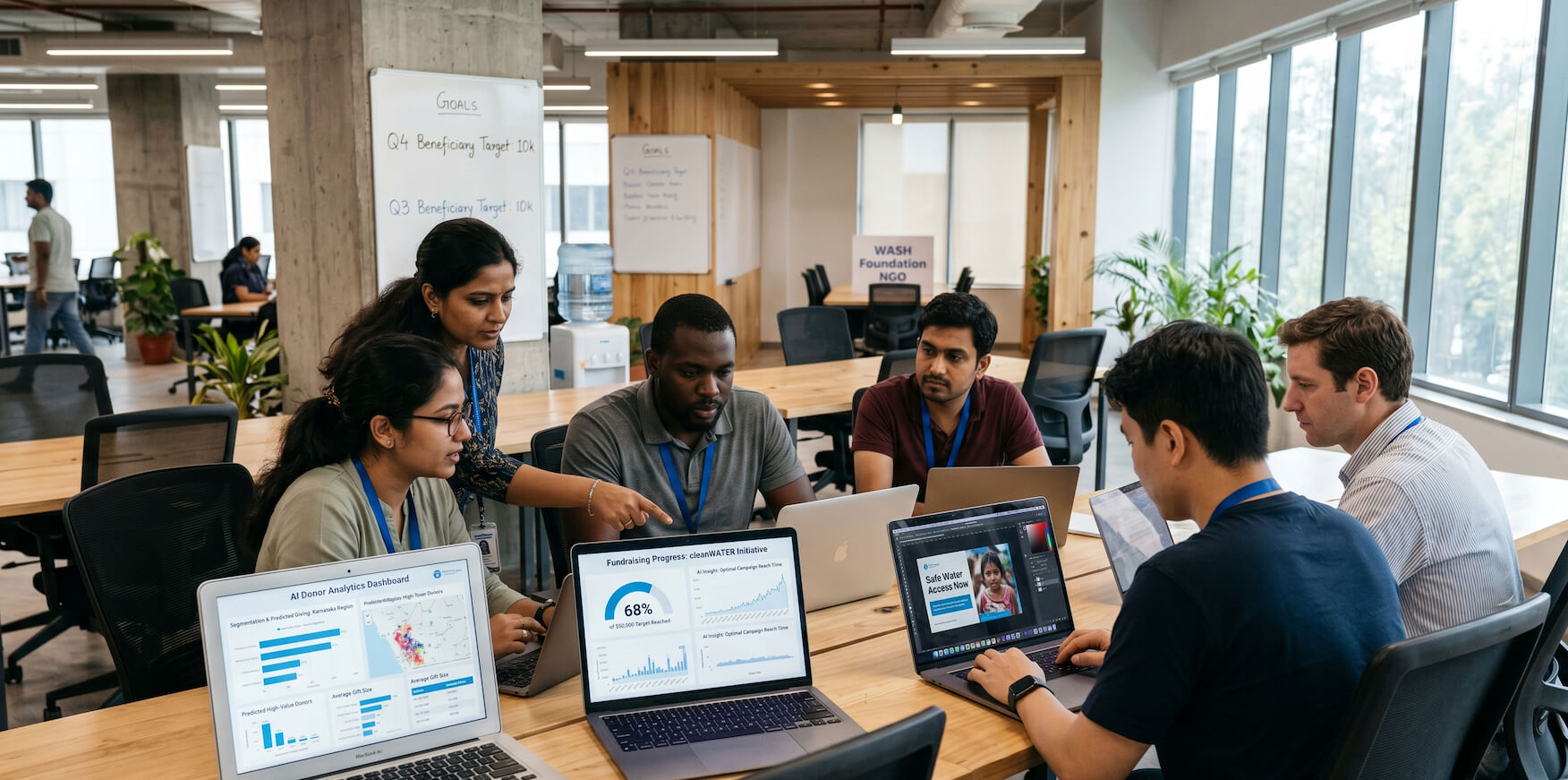
In 2026, NGOs are operating in an increasingly demanding environment where expectations continue to grow, but resources remain limited. Organizations are expected to demonstrate measurable impact, maintain transparency, and engage donors effectively—all while managing lean teams and constrained budgets.
This creates a fundamental imbalance between what needs to be achieved and the capacity available to achieve it.
Artificial Intelligence is helping resolve this challenge by enabling NGOs to extend their operational capabilities without increasing costs. Instead of hiring more staff or stretching existing teams further, organizations are now building intelligent systems that handle repetitive and time-consuming work.
The result is a shift from effort-based operations to system-driven efficiency, allowing NGOs to scale their impact sustainably.
Traditional NGO workflows rely heavily on manual effort. Tasks such as drafting proposals, responding to donors, managing data, and running campaigns often require significant time and coordination.
Over time, this leads to:
AI tools address these issues by automating key processes and supporting decision-making.
They help NGOs:
This allows organizations to shift focus from administrative work to mission-driven activities and strategic growth.
Communication plays a central role in NGO success, influencing funding, partnerships, and public trust.
ChatGPT enhances this function by acting as a multi-purpose content and communication engine.
Preparing grant applications is one of the most time-intensive tasks for NGOs. It requires clarity, structure, and alignment with donor expectations.
ChatGPT simplifies this process by:
This enables NGOs to increase the number of applications submitted without increasing workload, improving their chances of securing funding.
Maintaining consistent communication with donors is essential for retention and trust.
ChatGPT helps create:
This ensures communication remains professional and timely, even with limited staff.
NGOs often collect large volumes of data, but translating that into compelling narratives is challenging.
ChatGPT bridges this gap by:
This improves transparency and strengthens donor confidence.
Visual storytelling is critical for capturing attention and conveying impact effectively.
However, creating high-quality visuals consistently can be difficult without dedicated design resources.
Canva allows NGOs to move beyond individual designs and create a repeatable visual framework.
This includes:
Instead of designing each asset separately, NGOs can create complete campaign sets, including:
This reduces production time and ensures consistency across all communication channels.
Over time, this approach builds a recognizable visual identity, improving credibility and engagement while reducing design effort.
Donor relationships are at the core of NGO sustainability. Managing these relationships effectively requires more than basic data storage.
Salesforce Nonprofit Cloud introduces intelligence into donor management.
Instead of treating all donors the same, NGOs can analyze:
This enables more targeted and effective communication strategies.
AI-driven features help identify:
This shifts fundraising from reactive efforts to strategic planning.
By personalizing communication, NGOs can build stronger, long-term relationships rather than focusing on one-time donations.
Many NGO processes involve repetitive tasks across multiple tools, leading to inefficiencies.
Zapier connects these tools and automates workflows, creating operational continuity.
Zapier can:
Automation reduces manual work, minimizes errors, and ensures processes run smoothly without constant supervision.
This allows teams to focus on higher-value activities.
Modern audiences expect immediate responses, regardless of time or location.
AI chatbots enable NGOs to provide 24/7 engagement.
Chatbots can:
By offering instant support, chatbots:
They also play a role in conversions by assisting users at critical decision points.
Effective outreach is essential for NGO growth, but scaling communication manually is challenging.
HubSpot provides a structured system for managing this complexity.
HubSpot allows NGOs to segment audiences based on behavior and engagement, enabling:
Campaign performance can be tracked and analyzed, helping NGOs refine their strategies over time.
This creates a feedback loop where each campaign becomes more effective than the last.
The true power of AI lies in integration.
When tools like ChatGPT, Canva, Salesforce, Zapier, Intercom, and HubSpot are combined, they create a seamless operational system.
In this system:
This transforms fragmented processes into a cohesive, scalable workflow.
Even the most efficient systems cannot compensate for a lack of visibility.
If an NGO does not clearly communicate its mission online or provide easy ways for people to engage, it loses potential support.
This is why many organizations are now focusing on building strong digital platforms.
For example, NGOs are learning how to build a business website without coding using AI to create professional, donation-ready platforms quickly.
They also evaluate options by exploring why RocketPages is the best AI website builder to ensure their website is fast, secure, and optimized for visibility.
A strong digital presence allows NGOs to:
This turns interest into meaningful action and long-term support.
Selecting the right tools requires clarity about organizational needs.
Instead of adopting tools based on popularity, NGOs should focus on identifying their biggest challenges.
If communication is the main issue, content tools should be prioritized. If time constraints are the problem, automation tools provide the most value. If engagement is low, marketing and analytics tools become essential.
The key is to ensure that each tool serves a specific role within a larger system, avoiding unnecessary overlap.
While AI increases efficiency, excessive reliance on automation can reduce authenticity.
Potential risks include:
To avoid this, NGOs should use AI for repetitive and technical tasks while keeping human involvement in areas that require empathy, judgment, and relationship-building.
AI is fundamentally transforming how NGOs operate in 2026.
It allows organizations to:
However, the real advantage comes from combining: AI tools + strong digital presence + clear strategic direction
When used thoughtfully, AI does not replace human effort—it amplifies it, enabling NGOs to create greater impact with the resources they already have.
Stay up to date with the latest tips, expert insights, product reviews, and step-by-step guides to help you grow, create, and succeed—no matter your industry or passion.